
How financial firms can become trust brokers: Communications strategies to build trust in an insular world
Key Takeaways:
- The 2026 Edelman Trust Barometer shows people are increasingly insular, trusting only their close circles while distrusting institutions like government and media.
- Financial firms must earn their place inside trusted communities by acting as “trust brokers” who connect divided groups without taking polarizing positions.
- Asset managers and wealth advisors can broker trust by partnering with local, nonpartisan organizations, communicating in educational and nonideological ways, and training leaders to listen and translate across stakeholder groups.
We all know that the world has become increasingly divided. This has been a challenge for financial services firms seeking to communicate in a way that avoids hot button issues or polarizing topics. It has also made it difficult to build trust and bridge the divide.
The most recent release of the annual 2026 Edelman Trust Barometer finds that individuals are becoming increasingly insular. Seven in 10 people say they are hesitant or unwilling to trust someone who is different from them or has a different viewpoint, what Edelman calls an “insular trust mindset.” The report highlights the ongoing trend toward a decline in trust in shared institutions – government and the media. Instead, people invest their trust in neighbors, family and friends. The research highlights one bright spot. People trust business – especially “my employer” or “businesses in my backyard”.
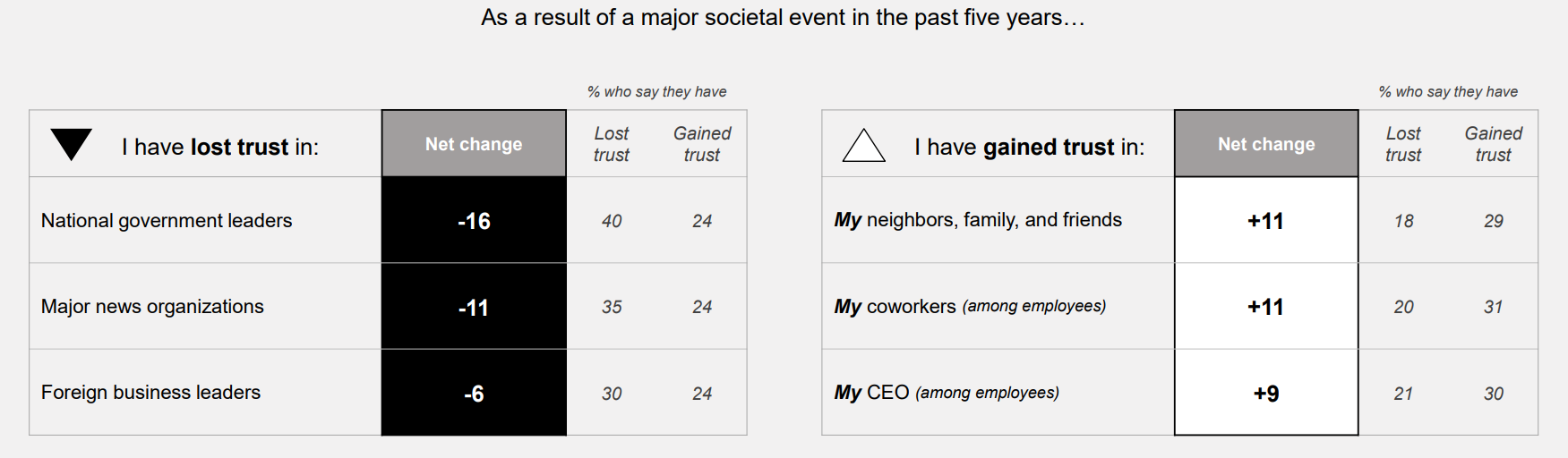
The challenge for financial firms—where trust is paramount—is how to be part of a trusted community and earn the right to serve people within it. But the challenge of increasing insularity is that many are unwilling or hesitant to trust someone new or different. The report highlights an increasing unwillingness to trust people with opposing political beliefs.
Trust brokering
Edelman introduces the term “Trust Brokering” as a potential solution to growing insularity. It is defined as a set of practices and behaviors that counter insularity by helping distrustful groups come together to understand one another and cooperate without trying to “convert” them.
Here are a few ways financial firms like asset managers and wealth advisors can become trust brokers:
- Partner with local trusted groups. Seek to align your brand or plan events with nonpartisan community organizations that are well regarded across the community. Co-sponsor an educational event with a university alumni group. Support a nonprofit community event. Highlight local leaders doing good work in the community
- When addressing divisive topics, convene diverse viewpoints and focus on cooperative problem-solving. Acknowledge and accept differences. Your communications should encourage cooperation to find solutions rather than taking a side.
- Present ideas in an educational way and avoid ideological or partisan opinions that can divide your audience. Create content that translates complex issues using neutral language and multiple lenses. Avoid ideological takes. Use Q&A formats or present various scenarios instead of assuming a single viewpoint.
- Train spokespeople and leaders to listen without judgment, acknowledge differences and translate concerns across all stakeholders (customers, communities, employees, regulators).
- Emphasize local story telling or testimonials (with permission) and provide examples of helping across communities with differing views.
- Use social proof with community references to elevate your local presence. Be sure to avoid sensational framing and invite civil dialogue and moderate discussions in ways that de-escalate conflict.
Subscribe.
Receive the latest news and insights from Lowe Group.