
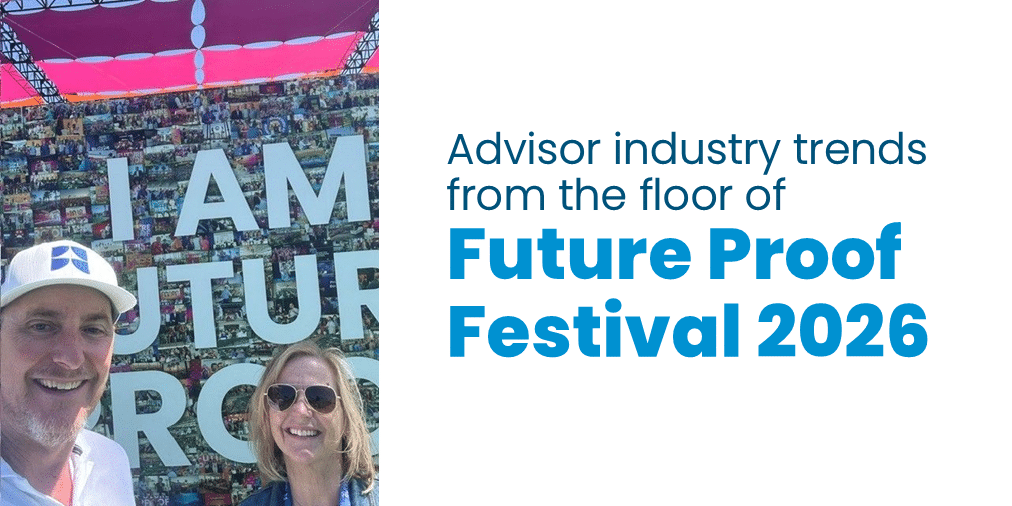
A few marketing lessons from the 2026 Future Proof Festival
- Larger-high growth advisory firms move beyond referrals and build real marketing functions once they break past the $5M revenue point
- Successful marketers combine digital strategies and “analogue” tactics like referrals, seminars and local sponsorships, but many high growth firms lean into one or two tactics that work well for them
- Across different sessions the common thread was the same – know exactly you serve and be indispensable to them
The 2026 Future Proof Festival featured numerous discussions about how advisors can market themselves including a mainstage presentation, several panel discussions and in-booth activations focused on ways to drive organic growth. Here are a few tidbits:
Research on what really drives advisor marketing growth
Michael Kitces, Chief Planning Nerd, Kitces.com (ranked #1 on our recent Centers of Finfluence survey) opened Day 2 of the conference with a mainstage presentation sharing his research on what advisors say drives growth.
The mistake many advisors make is investing in too many marketing tactics instead of finding the one or two that work for them, according to Kitces. “Find what works, stick with it and make it scale effectively with your business.
“Everything works and everything fails. What works is finding the tactic that works for you that you can iterate. Double down and figure out how to make it work better.”
Referrals are the default, but according to Kitces, they are not best practice. “Ultimately the well runs dry. You may get an immediate pop with new clients. Then you may get a few more referrals in five years when you become indispensable. But after 5 -7 years, they’ve referred everyone they know.”
The growthiest firms grow beyond referrals. Ultimately, advisor time becomes the bottleneck, especially once the firm exceeds $5 million in revenue. Eventually, growth-oriented firms need to establish a marketing function in order to separate sales from service.
The new playbook for RIA marketing
A panel offered insights on what is working in RIA marketing, including the impact of AI. Moderated by Joe Steuter, Chief of Client Strategy, Intention.ly, the panel included Deana Lewis, CMO, Mather Group, Joanna Irwin, CMO, HB Wealth and Anthony Stich, CMO, Moran Wealth Management.
The panelists had different views of the impact of AI. Lewis noted she used it mostly for audience intelligence to better target clients and for more precise targeting. But she doesn’t use it to create decks or original content.
Stich believes AI has made content cheap and has created a sea of sameness. Anecdotally he believes the human mind can discern the difference. Engagement on AI content goes down. “By 2030, 95% of the internet will be slop. Analogue is what works best. Relationships are still the number one way to differentiate yourself.”
Irwin leverages AI to optimize performance on digital channels. “We can create a set of approved images, headlines and calls to action, and AI can test them.” She tries to leverage data around client profiles and identify clients that would be a great fit based on their own proprietary data set. “Who are the new clients in the last two years and what do they look like?”
Lewis also cited tools that help to identify catalysts like money in motion to better understand why a potential client is calling. She also noted research shows that potential clients may use information from 12 different sources before making a decision.
Stich preferred to get back to basics. “The brain is lazy and wants to reduce the number of options to an evoked set – the three brands the brain tells you are right.” He tries to do local domination campaigns such as seminars, events and sponsorship in local market to beat bigger players on the ground.
Lewis also commented on the importance of a defined PR and earned media strategy. She intentionally positioned Mather Group spokespeople with interesting things to say on their blogs as a way to help them get noticed.
All agreed on the importance of building a clear client profile – employer or profession, life stage, demographics/psychographics. This includes being clear on who you serve and creating content that speaks to those audiences at a moment in time. The goal is to educate those right fit clients with consistent messaging through a content engine, review sites and socials that are all aligned. Each agreed on the need to do this through a blend of both analogue and digital channels.
Marketing in the age of constant content
Future Proof is full of booth activations including a smart discussion led by the team at Allspring Global. Allspring’s Head of US Intermediary Distribution Tony Svach moderated a panel including Meg Carpenter, CEO Ficomm Partners, Ian Karnell, CEO VastAdvisor and Kelly Vives, CMO Allspring Global.
Carpenter shared recent research on modern consumer buying behavior. When asked why consumers choose an advisor, the number one consideration is “they understand my needs.” Like the prior presenters, she also stressed that the most successful advisors have a clear point of view on who they serve and how they serve them distinctly from their peers.
Vives stressed how important it is to define the narrative. “Don’t be relevant to everyone. Be indispensable to someone.” Her firm has worked hard to identify the three things they consistently repeat in order to build brand overtime. “It takes people 12 or 13 exposures before they hear you. It needs to be authentic in order to resonate.”
Carpenter also shared research showing that the ultra-wealthy are the least likely to select an advisor based on a referral and much more likely to do their own due diligence and research. She also noted that on average investors turn to LLMs for their research about 8% of the time, up from zero a few years ago. That rises to 15% for high-net-work investors and to 25% among those under 25. The lesson is your firm needs to be worth finding.
PR was missing from many of the discussions
PR seemed to be treated as a side note in many of the marketing discussions at the conference. For many advisors, PR can be a very effective way to build awareness and to create assets that can be posted to websites or shared via social media or email. Many advisors can get strong engagement from earned media and relevant thought leadership that speaks to their target audience and it costs a lot less than equivalent engagement via paid-marketing efforts. And we know that LLMs read media sources and deprioritize owned media sites like websites making media exposure even more important in the age of AI.
Drop us a line if you want to learn more about PR and marketing strategies to grow your advisory firm.
Subscribe.
Receive the latest news and insights from Lowe Group.