

Kitces’ 2026 Marketing Study: The best marketers make advisors market less
Kitces’ 2026 Marketing Study: The best marketers make advisors market less
- Marketing pays for itself, but most of the cost is people’s time. Roughly two-thirds of marketing’s true cost is advisor and staff time.
- High growth firms market better, not more, and the fastest growing practices rely far less on referrals. Instead, they get very good at a few core tactics and take marketing off advisors’ plates.
- Content still works when it is done well and supported. While fewer advisors are investing in content, high-growth firms generate revenue through content at a much lower cost than the average advisor firm and supporting tactics can improve the success rate.
You can always tell a good conference session when other speakers and panelists at other sessions talk about it. At this year’s Future Proof, the one session I heard a lot of buzz about was Michael Kitces’ opening session reporting on his 2026 Marketing Study.
As I noted in a prior blog, there was no shortage of Future Proof sessions focused on advisor marketing and not everyone agreed with Kitces’ conclusions. But few could match the depth of Kitces’ findings. (See sidebar for data points that stood out to me.)
Leaning into tactics that are working
One of the oft-repeated conclusions from the Kitces presentation was that advisors shouldn’t just expand the number of marketing tactics they use but improve the effectiveness of their existing tactics: “…firms looking to improve organic growth shouldn’t start by asking, ‘What additional tactics should we add?’ They should first ask how to execute their existing tactics more effectively – and then use the resources generated from that successful growth to expand into additional tactics over time.”
Kitces also noted that the fastest-growing firms are actually the least reliant on client referrals for new revenue. Non-high-growth firms get roughly 80% of new revenue from referrals landing them in what Kitces calls the “referral coasting zone”. While firms have numerous reasons to avoid this zone, one of the biggest is that they will eventually exhaust the number of referrals available from their client base.
The most successful high-growth practices are more effective in their marketing spend: “…the most important factor contributing to the success of high-growth practices is simply that they market more efficiently – typically by learning, refining, and honing in on one or two core tactics that they’re especially good at, as measured by the cost required to acquire each additional dollar of new client revenue, or revenue acquisition cost (RAC).”
Detailed findings on a variety of tactics
The analysis in this report goes very deep, with very detailed charts on the effectiveness of a variety of factors. As a firm focused on PR and content for financial services firms, our antenna was up when we read that this year’s study found an overall decline in the use of at least one content creation tactic from 60% in 2024 to 51% in 2026. We speculate that the rapidly changing search environment is likely causing significant shifts in traditional content strategies. Kitces’ study noted the relatively large amount of advisor time required to craft content or secure media appearances, increasing the RAC.
Yet high growth firms are still getting good results from content with an RAC of $1.36 for $1 of new revenue versus $5.47 for everyone else. Content still works when done well and supported.
The study also identified interesting data on how using supporting tactics can increase success rates of content strategies. The most pronounced improvement, as noted in the chart below, came when writing for third-party platforms where adding supporting tactics effectively doubles the success rate.
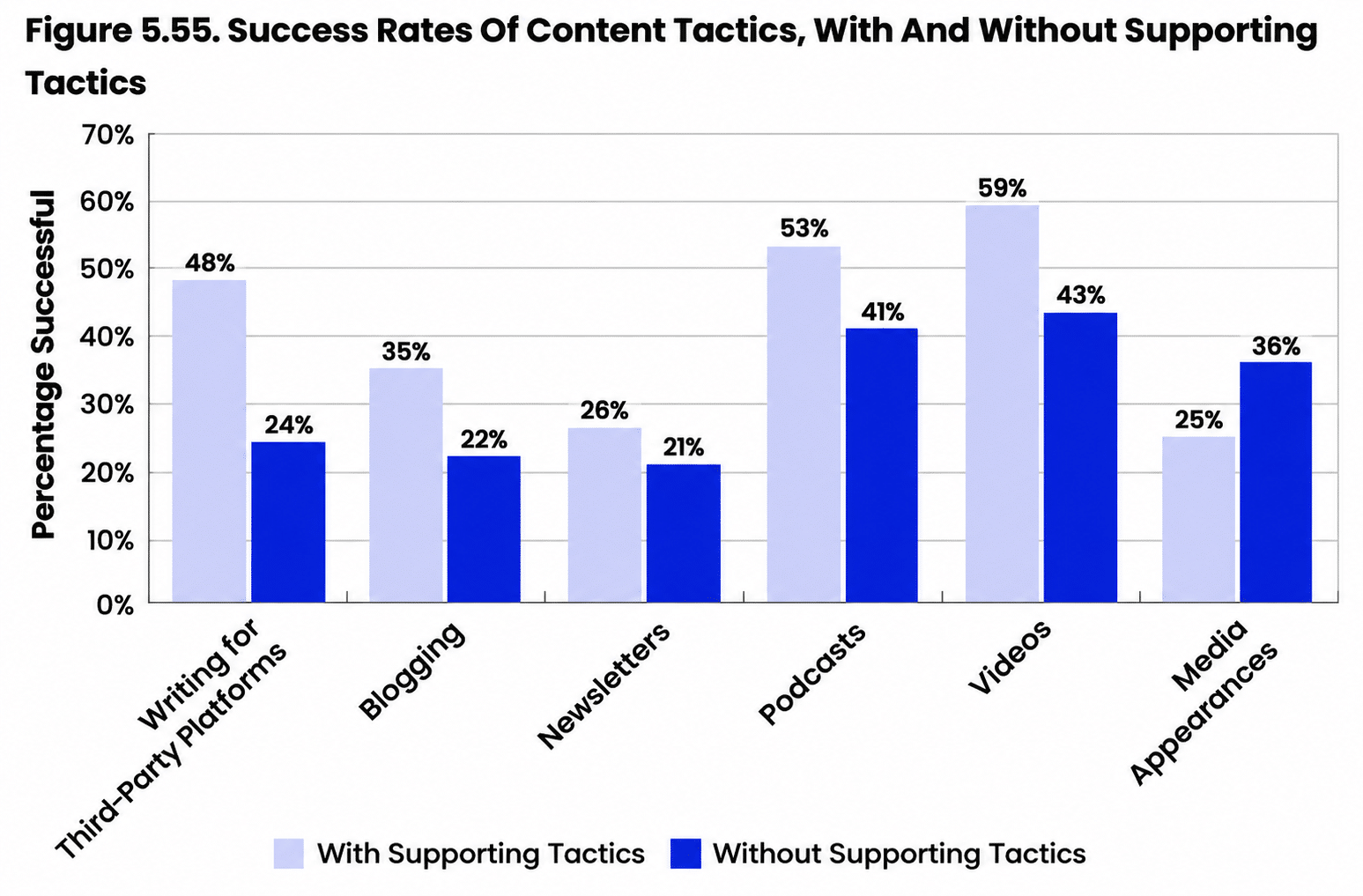
Source: Kitces 2026 Marketing Study
We agree with the study’s parting conclusion about the importance of protecting advisors’ time. Leaning into tactics that consistently work and improving on them can, over time, reduce the amount of time spent. We’ve seen how higher growth firms detach marketing from the individual advisors and centralize marketing work among experienced practitioners. The Kitces’ study notes: “One of the paradoxes of marketing success is that the firms that market most effectively are often the ones in which the advisor markets less (and the firm markets more on their behalf)!”
Subscribe.
Receive the latest news and insights from Lowe Group.